Castles in Southern Germany
In 2003 I took the family on a little trip to Europe. We visited Germany, Switzerland, Italy and Austria. Of course there were picture taken of the trip.
Here’s a brief history of the Castle:
Neuschwanstein Castle, perched on a rugged hill in southwest Bavaria, Germany, was conceived in the mid-19th century by King Ludwig II of Bavaria as a personal retreat and homage to the composer Richard Wagner. Ludwig, disillusioned with the political constraints in Munich, drew inspiration from his 1867 visits to Wartburg Castle in Thuringia and the Château de Pierrefonds in France. He envisioned a structure embodying medieval romanticism and the themes of Wagner's operas, such as Tannhäuser and Lohengrin. In May 1868, Ludwig sketched initial ideas for a Neo-Romanesque palace on the site of the ruined medieval castles of Vorderhohenschwangau and Hinterhohenschwangau, which he renamed Neuschwanstein (meaning "New Swan Stone Castle").
Construction began on September 5, 1869, after the ruins were demolished to make way for the new foundation. The project was designed by stage designer Christian Jank for the overall concept, with architect Eduard Riedel handling the execution. Materials included brick for the core structure, clad in limestone, marble, and sandstone. The cellar was completed by 1872, and the first floor by 1876. Subsequent architects Georg von Dollmann and Julius Hofmann took over as the design evolved. Ludwig funded the castle from his personal fortune and civil list, supplemented by loans, avoiding Bavarian state funds entirely. Costs ballooned from an initial estimate of 600,000 gold marks to over 6.2 million by the time of Ludwig's death, contributing to his debts of nearly 14 million marks.
Ludwig first occupied the unfinished palace provisionally in 1882 and more fully in 1884, but he resided there for only 172 days total. The castle featured innovative technologies for the era, including central heating, running water, and early telephones. However, Ludwig's extravagant spending and reclusive behavior led to political intrigue. In June 1886, Bavarian authorities declared him mentally unfit and deposed him. He was arrested at Neuschwanstein on June 12, but supporters briefly freed him before he was recaptured. Ludwig died mysteriously the next day, June 13, 1886, alongside his psychiatrist Bernhard von Gudden, in Lake Starnberg—officially ruled a drowning, though conspiracy theories persist.
At Ludwig's death, the castle remained incomplete, lacking a planned 90-meter keep, chapel, Moorish Hall, and other elements. Posthumous simplifications occurred, with the Bower and Knights' House finished by 1892, omitting ornate features like saints' figures. To recoup debts, Prince-Regent Luitpold opened Neuschwanstein to the public just six weeks after Ludwig's death, turning it into a revenue generator for the Wittelsbach family. After the 1918 revolution, the Bavarian republic assumed control of royal properties, and management shifted to the Bavarian Palace Department.
During World War II, the castle served as a depot for Nazi-looted art under the Reichsleiter Rosenberg Institute, storing thousands of items from occupied France. In 1944, 39 photo albums documenting the looting were hidden there and later discovered by Allied forces, now archived in the U.S. National Archives. The SS considered destroying the castle in 1945 to prevent its capture, but it was surrendered intact to the Monuments Men, who ensured its preservation before returning it to Bavarian authorities.
Neuschwanstein represents the pinnacle of 19th-century castle Romanticism and historicism, fusing Romanesque, Gothic, and Byzantine styles in an asymmetric layout. Its interiors, such as the grand Throne Hall with Byzantine-inspired mosaics and murals depicting apostles and saintly kings, and the Singers' Hall themed around Wagner's Parzival and Lohengrin, symbolize Ludwig's ideals of divine monarchy and mythological escapism. In 2025, it was designated a UNESCO World Heritage Site as part of "The Palaces of King Ludwig II of Bavaria," recognized for its outstanding example of architectural innovation and cultural heritage under criterion (iv). Today, standing at 65 meters tall and owned by the Bavarian state, it remains one of the most visited castles in Europe, embodying Ludwig's enduring legacy.
Enjoy
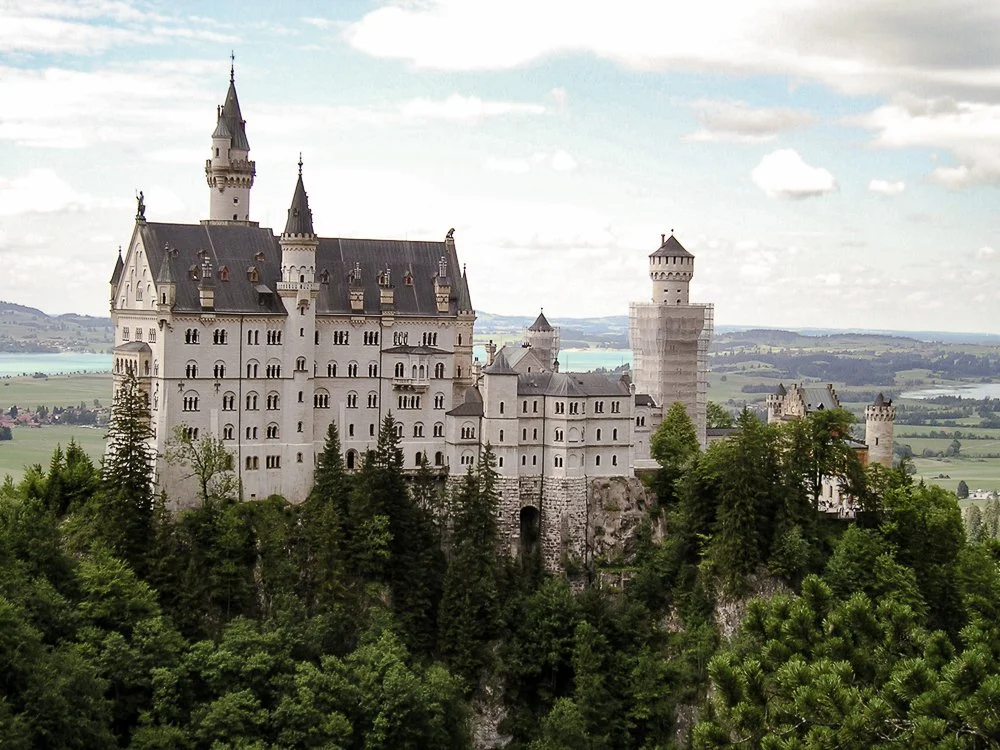
Neuschwanstein Castle