An abbreviated history
Early Foundations (1850s–1860s)
The key scientific principle behind color photography is the three-color (trichromatic) method, based on how the human eye perceives color through red, green, and blue (RGB) sensitivities. Scottish physicist James Clerk Maxwell proposed this in an 1855 paper on color vision.
Additive Screen Processes (Late 19th–Early 20th Century)
Early practical methods used additive color (mixing light, like RGB), often with screens or filters.
In the 1890s, processes like John Joly's screen plate (1894) used fine colored lines on glass.
The breakthrough came with the Autochrome Lumière, patented in 1903 and commercially marketed in 1907 by the French Lumière brothers (Auguste and Louis, also cinema pioneers). It used glass plates coated with microscopic dyed potato starch grains (red, green, blue-violet) as a color filter mosaic over a panchromatic emulsion. A single exposure produced a color transparency when viewed with light.
Subtractive Color and Modern Film (1930s Onward)
Subtractive color (using dyes to absorb/filter light, like CMY—cyan, magenta, yellow) enabled more practical films with multiple emulsion layers.
Kodachrome (1935), developed by musicians-turned-inventors Leopold Mannes and Leopold Godowsky in collaboration with Kodak, was a major leap. It was a color-reversal transparency film using complex processing (initially at labs only). It offered vibrant, stable colors and became iconic for slides and professional work.
Agfacolor Neu (1936) from Germany was another early subtractive multilayer film.
Kodacolor (1942) introduced practical color negative film for prints.
These films made color more accessible, though still more expensive and less sharp than black-and-white initially. By the mid-20th century, color was increasingly used in magazines, advertising, and amateur photography.
Digital Era and Dominance
Color photography became the norm in the 1970s–1980s as films improved (e.g., faster speeds, better color fidelity) and costs dropped. The shift to digital in the 1990s–2000s (with sensors using Bayer filters based on the same RGB principles) made color instantaneous and ubiquitous. Today, monochrome is largely artistic or niche.

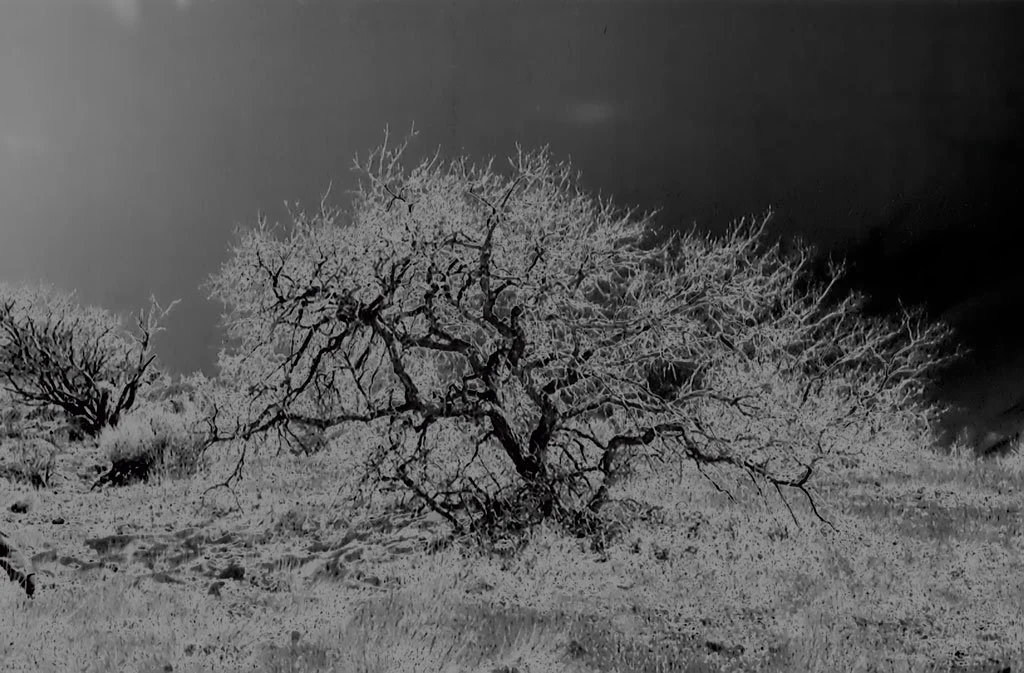

The above history brings new meaning to the Paul Simon Song Kodachrome which was invented by musicians! The above pictures where taken when I was taking photography classes in college or where influenced by that class. The photo of the tree is actually a solarization which is a black and white development process which adds a flash of light at the end of the development process.