First Troop Philadelphia City Cavalry
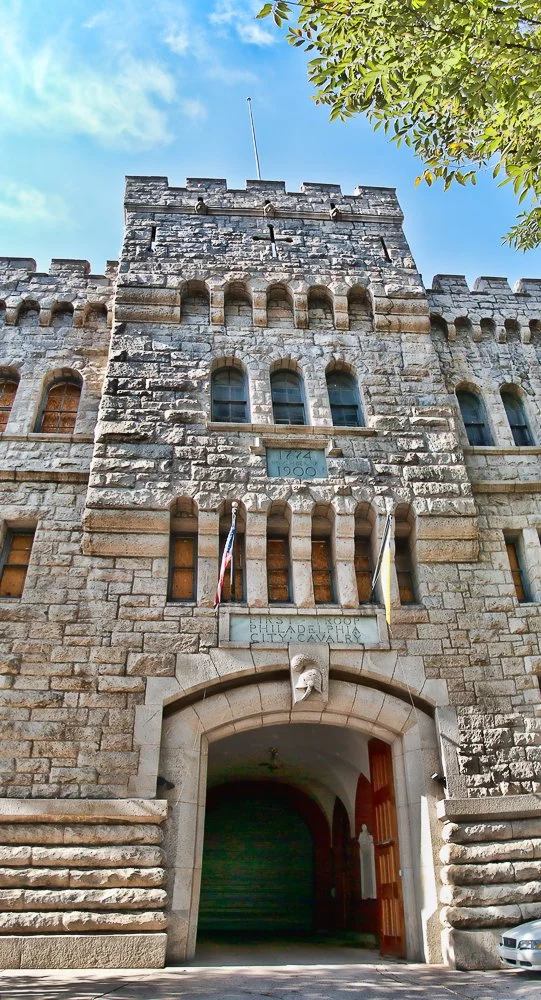
On a business trip to Philadelphia, PA in October of 2010, I took a photo of this building. The stone over the door is titled above. The building currently serves in part as a museum.
The museum at the First Troop Philadelphia City Cavalry Armory, located on the building's second floor, serves as a repository for the troop's extensive history spanning over 250 years of service in American conflicts. Opened in 1972, it underwent significant renovations following smoke and water damage from a fire, with updates completed to enhance curatorial conditions, add custom display cases mimicking original millwork but upgraded for conservation, and install a clean-agent fire suppression system to protect irreplaceable items. The 2,350-square-foot space now better accommodates additional exhibits while prioritizing artifact preservation, and the overall project, costing $1.4 million, was phased to address critical facade repairs alongside interior gallery improvements. Accessible via elevator or grand staircase from the dining room level, the museum is designed to welcome tourists, visitors, and members, though specific visiting hours or tours may require contacting the troop directly via their website (firsttroop.com) as it's part of an active military facility.
Exhibits chronicle the troop's role from its founding in 1774 through major U.S. wars, featuring a collection of historic military artifacts tied to the organization and broader national events. Key highlights include:
Revolutionary War artifacts: The original troop standard (a silk flag) dating to 1775, featuring intricate designs and symbols from the era; the flag flown by George Washington during his famous crossing of the Delaware River on Christmas night 1776; a handwritten letter from Washington sent after the Battle of Princeton in January 1777, thanking the troop for their service and discharging them temporarily; additional letters penned by Washington; and British colors (flags) captured by troopers following the British surrender at Yorktown in October 1781.
Battle streamers and colors: A display of the troop's colors adorned with battle streamers representing campaigns from the Revolutionary War to modern deployments, symbolizing honors earned in conflicts like Gettysburg, World War I, World War II, Iraq, and Afghanistan.
Uniforms and equipment: Mannequins and cases showcasing historical uniforms, such as elaborate 19th-century cavalry jackets with braided details, epaulets, and buttons; helmets, sabers, horse pistols, and other weaponry from various periods; and gear from mechanized eras, including items from the troop's reorganization as a tank unit in the mid-20th century.
Photographs and memorabilia: Black-and-white images depicting troop activities, such as 1950s troopers working with M4 Sherman tanks; portraits of notable members and commanders; and assorted memorabilia like medals, documents, and ephemera from Civil War battles, World War efforts, and recent missions.